Nigeria: Outrage in Osun as EFCC freezes state gov’t account

By Zuleihat Owuiye, Nigeria
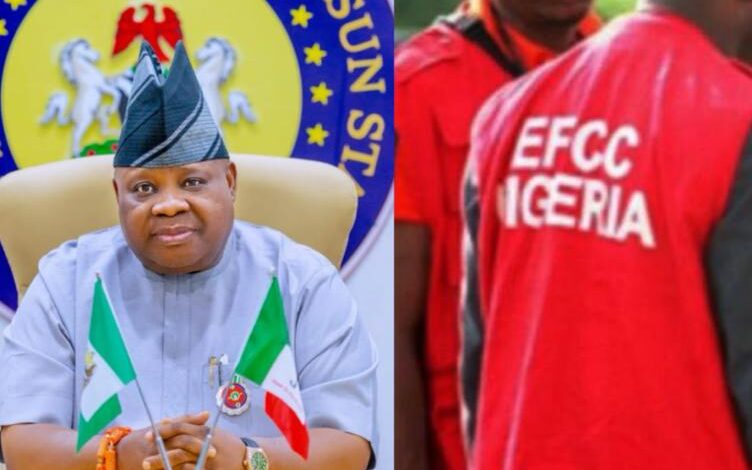
OSOGBO — The Economic and Financial Crimes Commission has frozen a major account of the Osun State Government, triggering strong backlash from Governor Ademola Adeleke, opposition parties, and legal experts just 10 days before the state’s governorship election.
The account, domiciled with a first-generation bank, was placed on “Post-No-Debit” on August 5, 2026, according to an EFCC letter signed by the Director of Investigation, Adenike Babalola. The commission cited Section 38(1) & (2) of the EFCC Act 2004 and Section 24 of the Money Laundering Prevention and Prohibition Act.
The EFCC said it took the action to protect public funds while investigations are ongoing.
In a statement, EFCC Head of Media and Publicity, Dele Oyewale, said the commission has been probing the Osun government since March 2026 over alleged fraudulent handling of Ecology Funds, Intervention Funds, and FAAC allocations totaling about N11 billion.
According to the EFCC, the Accountant-General and other officials have already been interviewed. The commission said it would not have restricted the account but for “precipitate and unwarranted movement of funds” to different corporate entities since August 2, 2026.
“The commission noticed huge transfers of funds into different corporate entities and had to swiftly halt the trend by freezing the accounts,” Oyewale said. “The EFCC’s preventive mandate is a public-inclined framework of safeguarding public funds. We cannot watch idly while a state government’s account is being pillaged.”
The commission stressed that it is non-partisan and that it is also monitoring finances in other states ahead of elections.
Governor Adeleke described the freeze as an abuse of the rule of law and an attack on democracy.
“All I ask is for the EFCC chairman to explain to the good people of Osun State and to Nigerians why he froze Osun State Government account, and show proof to support whatever reason he presents,” Adeleke said in Osogbo.
He said he has directed the Attorney-General and Commissioner for Justice, Oluwole Jimi-Bada, SAN, to challenge the action at the Federal High Court in Osogbo.
Jimi-Bada argued that the EFCC lacks the power to freeze a state’s statutory account. He said Sections 24 of the Money Laundering Act and 38 of the EFCC Act do not give the commission authority to restrict funds meant for salaries, pensions, healthcare, education, and security.
“Osun State is not opposed to any lawful investigation,” the AG said. “We remain committed to transparency and accountability. However, all investigative power must be exercised within the limits of the Constitution and applicable laws.
The Accord Party accused the EFCC of trying to tilt the August 15 governorship election in favor of the APC. National Chairman Chief Maxwell Mgbudem called the action “unconstitutional” and said the commission acted without a court order. He vowed to challenge it in court.
The African Democratic Congress, ADC, went further, calling it “political terrorism.” National Publicity Secretary Mallam Bolaji Abdullahi said withholding funds was part of a wider campaign to weaken the state government. He argued that ordinary citizens are the ones suffering, as money meant for salaries, primary healthcare, and schools is now tied up.
“Political opponents are not enemy combatants. Opposition-controlled states are not occupied territories,” Abdullahi said.
Legal practitioners were divided on the legality but agreed on the need for due process.
SAN Kunle Edun said no court would grant such an order days to an election, warning that freezing the account amounts to “shutting down the entire state.” He added that appellate decisions do not support the EFCC interfering in how states manage funds.
Chukwuma Omezie said the EFCC must obtain valid court orders and explain itself clearly if the freeze affects workers’ salaries. “If the action was backed by a valid court order based on credible evidence, it would be difficult to fault the commission purely because of the timing,” he said.
Evans Ufeli called it “executive recklessness” that undermines public trust, while Abuja-based lawyer Abdullahi Musa described it as a “dangerous precedent” ahead of next year’s general elections.
Bartholomew Ojonugwa recalled a similar dispute over withheld LG allocations in Osun that reached the Supreme Court. He advised the state AG to immediately challenge the freeze in court
The Osun APC responded by asking the EFCC and ICPC to probe alleged vote-buying by the state government. Media Committee Chairman Remi Omowaiye claimed the administration was paying N20,000 directly to workers and residents as a political inducement.
Governor Adeleke’s spokesperson, Olawale Rasheed, denied the claim, saying the payments were part of periodic palliatives to civil servants to augment salaries, a program started before the new minimum wage.
With the election scheduled for August 15, the legal challenge is expected to move quickly. The core dispute is whether the EFCC can freeze a state’s main account without a court order, and whether doing so so close to an election constitutes political interference.
For now, the account remains restricted. The outcome of the court case and the EFCC’s ongoing investigation will determine if the funds are released and what happens to the N11 billion being probed.