PART 2: Revisiting and analysing the article I wrote following Ousmane Sonko’s inaugural speech

by Ndey Jobarteh
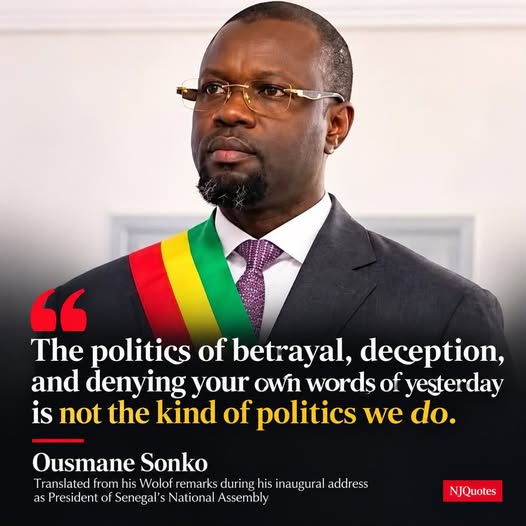
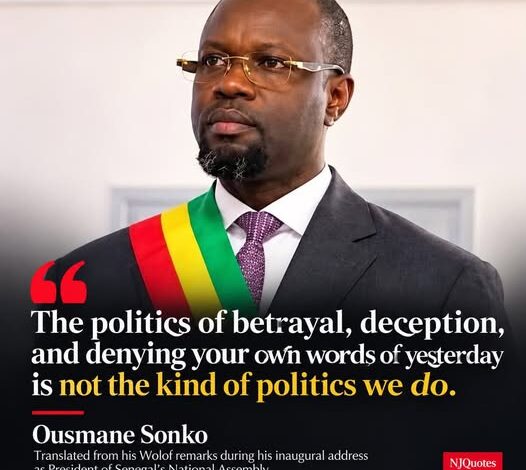
“The politics of betrayal, deception, and denying your own words of yesterday is not the kind of politics we do.”
—Ousmane SONKO, translated from his Wolof remarks during his inaugural address as President of Senegal’s National Assembly
This is a direct challenge to a political culture in which abandoning principles, changing positions for convenience, and contradicting yesterday’s words are too easily justified in the name of politics.
For decades, Africans have heard the phrase:
“In politics, there are no permanent friends and no permanent enemies, only permanent interests.”
It has become one of the most convenient explanations for political defections, unlikely alliances, and the abandonment of promises made to voters.
But Sonko’s argument challenges us to distinguish between changing political strategy and abandoning political principles.
A leader may change strategy!
A leader may negotiate!
A leader may compromise!
A leader may even work with a former political opponent!
But changing strategy should not automatically mean changing your values.
There is an important difference between compromise and contradiction, between political flexibility and political opportunism, and between building an alliance for a stated public purpose and abandoning everything you previously told the people you stood for.
This is why the phrase “there are no permanent friends or enemies in politics” should never end the discussion.
It should begin another one:
What is the permanent interest?
Is it access to power?
Political survival?
Personal advancement?
Or is it the nation and its people?
Political alliances may change!
Circumstances may change!
Strategies may change!
But if principles change every time political circumstances change, what exactly does the politician stand for?