Nigeria: Russia, Ukraine trade blame over ceasefire breaches

By Zuleihat Owuiye, Mamos Nigeria
Russia and Ukraine exchanged accusations on Monday, May 11 2026, over violations of a three-day ceasefire brokered by the United States, though both sides reported no major strikes and fighting remained limited compared to recent weeks.
The truce, announced unexpectedly by US President Donald Trump, came into effect to coincide with Russia’s World War II Victory Day celebrations. The agreement also includes a planned exchange of 1,000 prisoners from each side in the coming days, marking one of the largest prisoner swaps since the war began in 2022.
Within hours of the ceasefire taking effect, Kyiv and Moscow began trading blame for breaches. The Ukrainian General Staff said that “since the beginning of the day, the number of attacks by the aggressor has reached 51,” referring to Russian military activity along the front lines.
However, the Ukrainian air force noted a significant drop in aerial attacks. It reported that Russia launched just 44 drones from 6:00 pm on Friday, one of the lowest daily totals recorded in recent months. The reduction in drone activity suggests that while skirmishes continued, both sides largely refrained from large-scale offensives.
Moscow offered a different account. The Russian defence ministry said that “despite the declaration of a ceasefire, Ukrainian armed groups launched attacks using drones and artillery against our troops’ positions.” It did not provide a specific number of alleged violations on Saturday.
The competing claims reflect a pattern seen in previous short-term truces, where both sides accuse the other of undermining agreements while avoiding escalation that could derail diplomatic efforts.
Although major strikes were absent, casualties were still reported on both sides. Russian drones killed two civilians and wounded three in Ukraine’s central-eastern Zaporizhzhia and Dnipropetrovsk regions, according to local authorities. The attacks occurred outside the capital region but highlighted the continued risk to civilians even during negotiated pauses in fighting.
In Russia’s western Belgorod region, which borders Ukraine, three people were wounded by Ukrainian drone strikes, said regional governor Vyacheslav Gladkov. Belgorod has been a frequent target of cross-border drone and artillery fire since early 2024.
No attacks were recorded on Moscow’s Red Square, where Russia held its annual Victory Day parade. The event proceeded without incident, with President Vladimir Putin using the occasion to mark the 81st anniversary of the Soviet victory over Nazi Germany and to frame the current war in Ukraine as part of that historical struggle.
The three-day ceasefire was timed to overlap with Russia’s May 9 commemorations, a date of major symbolic importance in Moscow. US officials said the timing was intended to create a window for de-escalation and to facilitate the prisoner exchange.
President Trump announced the truce earlier in the week as part of renewed US diplomatic engagement aimed at reviving stalled peace talks. The planned exchange of 1,000 prisoners from each side would be the largest since the war began and is seen as a confidence-building measure ahead of potential negotiations.
Both Ukraine and Russia confirmed that preparations for the swap were underway, though details on timing and location have not been disclosed. Prisoner exchanges have been one of the few areas of consistent cooperation between the two sides throughout the conflict.
The current ceasefire is not the first of its kind. The four-year war has seen occasional short-term truces, typically declared around Orthodox Easter and other holidays. These pauses in fighting have often been marked by mutual accusations of violations and have rarely led to sustained de-escalation.
Analysts say the limited nature of the current truce reflects both the deep mistrust between Kyiv and Moscow and the tactical realities on the ground. Neither side appears willing to cede ground or pause offensive operations for an extended period without clear guarantees.
The war has cost hundreds of thousands of lives and forced millions to flee their homes, making it Europe’s deadliest conflict since World War II. Front lines have remained largely static for over a year, with fighting concentrated in eastern and southern Ukraine.
The US-brokered ceasefire represents the most significant diplomatic push by the Trump administration since it resumed office in January 2026. Washington has sought to reframe its role in the conflict, emphasizing direct engagement with both Kyiv and Moscow to reduce escalation and create space for talks.
European allies have cautiously welcomed the initiative but remain skeptical about its durability. The European Union and NATO have reiterated support for Ukraine’s territorial integrity while calling for accountability for alleged ceasefire violations.
The United Nations has urged both sides to respect the truce and to use the window to facilitate humanitarian access and civilian evacuations in affected areas. Humanitarian organizations have reported that even short pauses in fighting allow aid deliveries to reach communities cut off by active combat.
Military analysts say the drop in drone strikes reported by Ukraine aligns with broader trends observed in recent months. Both Russia and Ukraine have faced constraints on drone production and supply chains, leading to more targeted use of unmanned aerial vehicles.
Ground fighting remains concentrated in Donetsk, Luhansk, Zaporizhzhia, and Kherson regions. Neither side has reported significant territorial gains in the past week, and both continue to fortify defensive positions in anticipation of future offensives.
The use of artillery and small-unit assaults has continued at a lower intensity, consistent with what military experts describe as a “managed conflict” during the ceasefire period
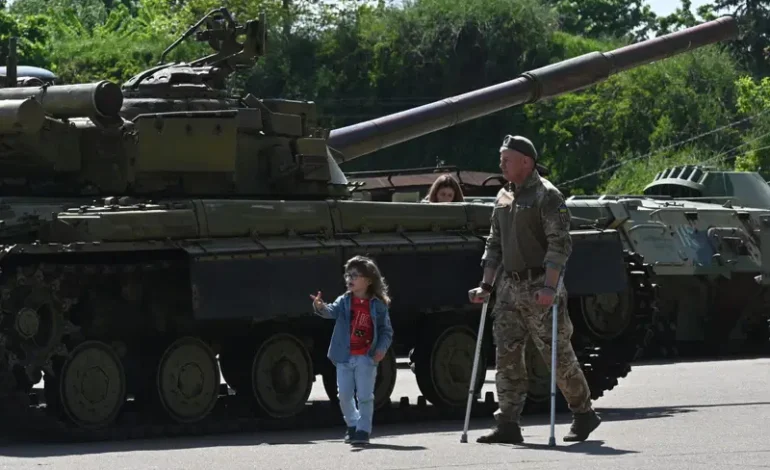
In Kyiv, residents marked Victory Day with memorials at the National Museum of the History of Ukraine in the World War II. Images showed a wounded Ukrainian serviceman walking with his daughter past military equipment on display, a scene that underscored the war’s personal toll.
Public sentiment in Ukraine remains supportive of the war effort but wary of ceasefires that do not include guarantees for territorial integrity. Many view the truce as a tactical pause rather than a step toward peace.
In Russia, state media framed the ceasefire as evidence of Moscow’s commitment to peace, while blaming Ukraine for undermining the agreement. The Victory Day parade emphasized themes of national resilience and historical continuity, linking the current conflict to the Soviet experience in World War II.
The immediate focus is on the planned prisoner exchange, which could take place within the next 72 hours if the ceasefire holds. Successful implementation would provide both sides with a domestic political win and potentially open the door to further talks.
However, without a mechanism for monitoring and verifying violations, the truce remains fragile. Previous agreements have collapsed within days due to accusations of non-compliance and retaliatory strikes.
US officials have indicated that they are exploring options for third-party monitoring, though no agreement has been reached on the format or mandate of such a mission.
The US-brokered ceasefire between Russia and Ukraine has reduced the intensity of fighting but has not eliminated it. Mutual accusations of violations and continued low-level attacks underscore the fragility of the agreement and the depth of distrust between the two sides.
For now, the truce provides a brief respite for civilians and a chance to advance the prisoner exchange. Whether it leads to broader de-escalation or collapses like previous truces will depend on the willingness of both Kyiv and Moscow to restrain military action and engage in meaningful diplomacy.
As the war enters its fifth year, the international community continues to watch for signs that this pause could become the foundation for a more lasting resolution.