The Myth of a “Swift Rectification”: Deconstructing the IEC’s Defence of the Missing 3,713 Voters

by Ndey Jobarteh
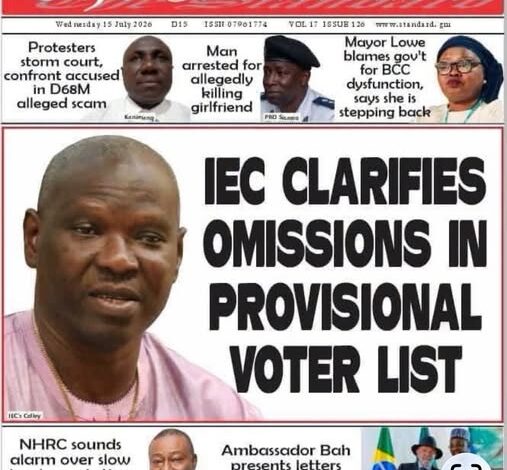
“Also clarifying the issue, IEC Chief Electoral Officer Samboujang Njie explained that the omission only affected those registered on the first day of registration.
“Those registered on that specific day were not included in the provisional list, but it was actually corrected, and the updated list was given to the complaining parties,” Njie said, adding that there was no cause for alarm since the electoral law provides mechanisms for appeals, corrections and objections.
“In fact, as the name indicates, the provisional list is not final. Hence, objections, appeals and corrections can be made until July 20, after which the revising courts will start. So the law has taken care of all these issues,” he added.
The clarifications came after one of the complainants, UDP-Bakau Organising Secretary and Deputy Campaign Manager Wally Sanyang, alleged that more than 70 names were missing across several registration centres in Bakau. He disclosed that, in Cape Point alone, 43 names were missing; 8 at the Bakau Community Centre; 18 in Farokono; 4 in Bakau Wasulung; and 15 in Bakau Sanchaba, while Newtown and Fajara were yet to be confirmed.
Wally confirmed that IEC officials were in Bakau to paste a new voter list but claimed that, even after that correction, some names still remained missing.”
— Standard Newspaper The Gambia
1. The Admission vs. Database Integrity
The IEC’s Claim: IEC Chairman Joseph Colley and Chief Electoral Officer Samboujang Njie officially stated that 3,713 names were successfully captured in the IEC’s database but were somehow not printed on the provisional voter lists. Njie claims this was a glitch that “only affected those registered on the first day of registration.”
Admitting that the data existed securely in the system but failed to appear on the printed voter list is a massive red flag regarding the integrity of the system. If the data was securely stored in the database, the failure to print it raises serious questions about the reliability of the system and its quality control processes. Dismissing a 3,713-person printing failure as a simple “first-day” anomaly ignores the severity of the technical breakdown that allowed it to happen.
2. The Failure of the “Swift Rectification”
The IEC’s Claim: Chairman Joseph Colley stated that once the omission was discovered, it was “swiftly rectified” and that an updated list was provided to the complaining parties.
The reality on the ground appears to contradict the IEC’s claim that the issue was fully resolved. UDP-Bakau Organising Secretary Wally Sanyang confirmed that, even after IEC officials visited the centres to paste the new, supposedly corrected voter lists, some names still remained missing. This raises serious questions about whether the IEC’s “swift” correction process was sufficient to restore all affected voters.
3. Weaponising the “Provisional” Status
The IEC’s Claim: Samboujang Njie argues that there is “no cause for alarm” because the voter list is deliberately provisional and not final. He points out that the law provides a window until July 20 for objections, appeals and corrections before the revising courts take over, arguing that “the law has taken care of all these issues.”
The IEC appears to be relying on the provisional nature of the register to justify a serious administrative failure. The correction period is intended for routine, individual clerical errors, such as a misspelled name or an incorrect date of birth. It should not be used to excuse the omission of 3,713 registered voters whose names had already been captured in the database. By doing so, the IEC shifts the burden of identifying and correcting its own errors onto citizens and political parties, forcing them to audit the lists and seek corrections before the deadline.
Finally, the IEC’s response attempts to frame a serious, multi-thousand-person failure as a minor and easily correctable printing error. However, reports that some names remained missing even after the publication of the revised voter lists raise legitimate questions about the effectiveness of the correction process. Combined with the reliance on citizens and political parties to identify omissions and request corrections, this points to significant concerns about administrative oversight, quality assurance and accountability.
I will also be presenting the statements of Lamin Manneh, UDP Secretary for Foreign Affairs and Diaspora, and Alhagie Mamadi Kurang of the UDP on this matter. After listening to their interviews, I believe the situation should concern every Gambian.
Thank you so much, United Democratic Party (UDP) , for your dedication and vigilance. Safeguarding the integrity of the voters’ register is in the interest of every Gambian.
Regardless of political affiliation, we all have a shared responsibility to remain vigilant and to follow the voter registration and verification process carefully. The integrity of our elections depends not only on the institutions responsible for administering them, but also on the active participation and vigilance of citizens in ensuring that every eligible voter is properly registered and accounted for.
Thank you to everyone who has been bringing this issue to my attention. I simply wanted to take the time to understand it fully before commenting.
Please take a moment to check the provisional voter list and make sure your name is there.
If your name is missing or any of your details are incorrect, report it immediately through the appropriate channels before the correction period closes.
Image source: Paradise TV Gambia