
Nigeria: Man who survived being trapped inside a whale shares experience

By Zuleihat Owuiye, Nigeria
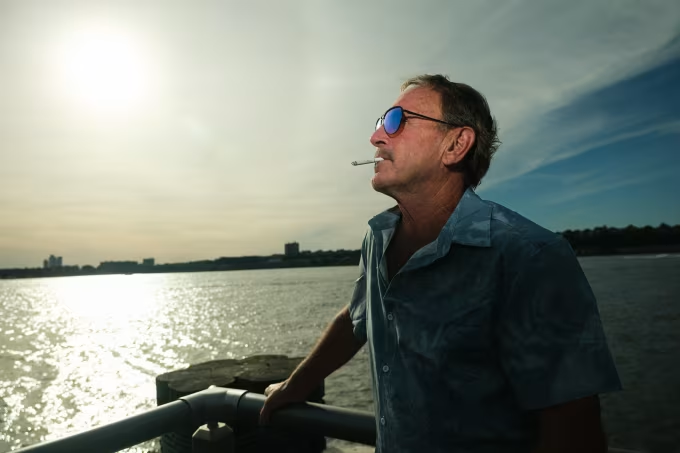
Michael Packard, a lobster diver who survived being trapped inside a humpback whale in 2021, has shared his reaction to Whalefall, a new survival thriller inspired by the terrifying possibility of being trapped inside a giant sea creature.
Packard, 62, attended a preview screening of the film in New York’s Times Square alongside actors Josh Brolin and Austin Abrams. His real-life encounter bears similarities to the movie’s central premise, although he insists that he was never swallowed by the whale.
“I wasn’t swallowed. I was trapped in its mouth,” Packard explained to the audience, leaving Brolin visibly astonished.
The incident happened on June 11, 2021, when Packard was diving for lobsters off the coast of Provincetown, Massachusetts. His extraordinary survival story later attracted international attention and has become a point of comparison for the new film.
Although Whalefall is not directly based on Packard’s experience, the movie shares themes of survival, fear, family relationships and the struggle to stay alive when confronted with overwhelming danger.
The film, adapted from Daniel Kraus’ 2023 novel of the same name, follows a young diver who becomes trapped inside a sperm whale while searching for his late father’s remains.
Packard had spent much of his life around the ocean. His interest began when he was 12, after his mother saved enough money to buy him a small boat.
Over the years, lobster diving became both his profession and a way to find peace. He described the underwater environment as a place where he could temporarily escape the depression he experienced during winter.
On the morning of the incident, Packard had already completed one dive and handed a bag of live lobsters to his crewmate, Josiah Mayo, who was waiting aboard his boat, the Ja’n J.
The vessel was named after his two sons, Jacob and Josiah.
Packard returned underwater for another dive when he suddenly felt a powerful impact. Water rushed around him, and darkness surrounded him.
Initially, he suspected that a shark had attacked him. However, he soon realised that he had not been bitten. Instead, he was being squeezed inside what felt like an enormous animal’s mouth.
He quickly concluded that a humpback whale had picked him up accidentally.
Humpback whales can grow to around 60 feet long and weigh up to 40 tons. They feed by taking large mouthfuls of water containing small prey, including krill, before filtering the water through specialised baleen plates.
Humans are not part of their normal diet, and their throat openings are too small to swallow an adult person whole.
Packard’s experience was nevertheless terrifying.
The force of the encounter had knocked the breathing regulator out of his mouth. He reached behind himself, found the equipment and managed to put it back in place so he could continue breathing.
He then attempted to push against the inside of the whale’s mouth, hoping to force his way out. But the enormous animal’s movements and the pressure around him made escape impossible.
Packard could feel the whale’s tongue contracting against his body as the animal moved.
“It felt like I was inside of a live creature that was trying to eat me,” he recalled.
He estimated that he remained inside the whale’s mouth for between 30 and 45 seconds.
Although he understood that a humpback whale could not swallow him whole, he feared that he might remain trapped until his oxygen supply ran out.
The possibility of suffocating underwater frightened him even more than the thought of being eaten.
As he struggled to survive, Packard thought about his two sons and his mother. He worried about how his death would affect them and the future he would no longer be able to share with his children.
Then, without warning, the whale released him.
The animal rose towards the surface and expelled Packard from its mouth in a powerful burst of water. Mayo and another nearby mariner witnessed the incident.
When Mayo pulled him aboard the boat, Packard was overwhelmed by shock and emotion. He was also experiencing pain in his knee.
He recalled shouting to his crewmate that he had been inside a whale’s mouth and had somehow survived.
More than five years after the encounter, Packard attended the Whalefall screening in Times Square, where he shared his experience with other guests.
The event featured ocean-themed decorations, including a model whale that visitors could pose inside.
Packard admitted that watching the film’s trailer had given him what he described as “shiver bumps”. However, he decided to watch the movie despite concerns that its intense scenes might bring back frightening memories.
Directed by Brian Duffield, Whalefall stars Austin Abrams as Jay, a young diver who ventures into the waters off Monterey, California, to recover the remains of his deceased father, Mitt, played by Brolin.
Jay and his father had a troubled relationship, with their history explored through flashbacks. Mitt eventually dies in the ocean after choosing to end his life rather than face terminal cancer.
During his underwater mission, Jay encounters a giant squid being pursued by a sperm whale. He becomes entangled in the squid’s tentacles and is subsequently swallowed by the whale.
The film then follows his desperate attempt to escape before his oxygen supply runs out.
Jay faces a series of frightening challenges inside the animal, including corrosive stomach fluids, dangerous pressure changes and hallucinations. His struggle also forces him to confront painful memories of his father.
Although the events portrayed in the film are considerably more extreme than Packard’s real-life encounter, he said several aspects of Jay’s experience felt familiar.
He identified with the character’s claustrophobia, helplessness and determination to survive, alongside the growing fear that escape might be impossible.
Packard also recognised the sensation of being pressed by a whale’s moving tongue.
“He was there where the tongue was contracting, and I could feel the tongue of my whale contracting on me, and the movements of this giant animal, so I could totally relate,” he said.
For Packard, the similarities made the experience more than just another Hollywood survival story.
The whale incident was not the first time Packard had narrowly escaped death.
He previously survived a near-drowning when he was 14. In 2001, he was also involved in a plane crash in Costa Rica that killed several people.
Packard was left injured on the jungle floor for two days before being rescued.
His survival of the whale encounter added another extraordinary chapter to his life.
In the years since the incident, he has appeared on television programmes and participated in interviews to recount what happened. He appeared on Jimmy Kimmel’s show shortly after the encounter and later took part in the documentary In the Whale.
Packard has continued sharing his story, describing the reactions of people who struggle to imagine what it would feel like to be caught inside such a massive animal.
He believes that recounting the experience has given his life a renewed sense of purpose.
Rather than focusing solely on the terror he endured, he has come to appreciate the wonder and amazement his story inspires in others.
The title Whalefall has a meaning beyond the film’s terrifying premise. In marine biology, the term describes what happens when a whale dies and its body sinks to the ocean floor, creating a source of nutrients for other marine organisms.
As scavengers consume the remains, the carcass enriches the surrounding environment. The whale’s skeleton can also provide a habitat for deep-sea creatures for decades.
The natural process offers a reminder that something seemingly tragic can eventually support new life.
Packard sees a similar possibility in his own story. An experience that could easily have ended in tragedy has become a source of fascination and inspiration for people around the world.
His encounter also highlights the unpredictable nature of life in the ocean, where even an experienced diver can suddenly find himself in an almost unimaginable situation.
For Packard, telling the story is now part of how he makes sense of what happened.
“I love to give people that sense of wonder and awe,” he said. “It feels good to make other people feel good.”
Through his survival story and his reaction to Whalefall, Packard has found a way to turn a terrifying encounter into a lasting reminder of human resilience, the power of storytelling and the extraordinary experiences that can change a person’s life.