Barrow calls for stronger democratic institutions as Gambia hosts historic tripartite conference

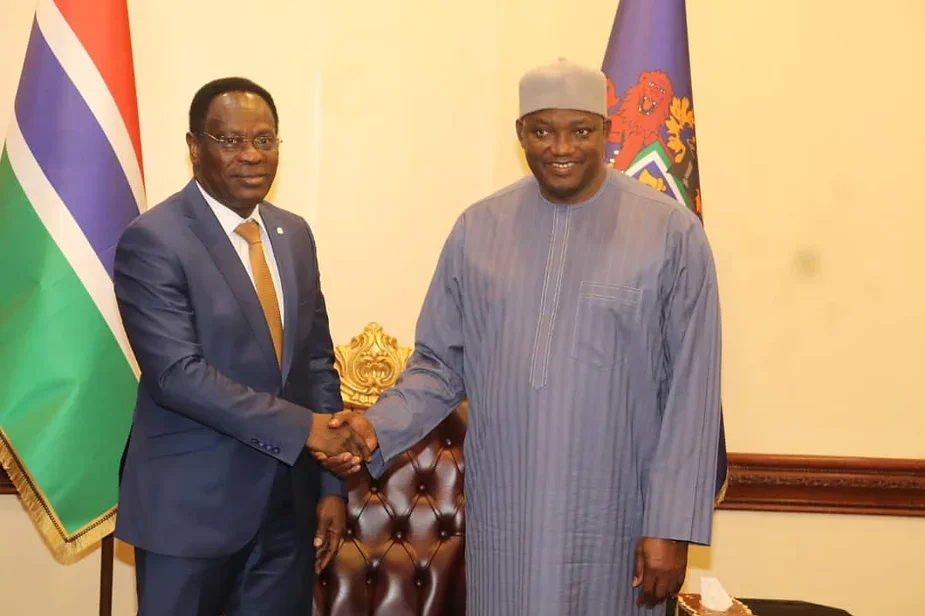
President Adama Barrow yesterday reaffirmed his government’s commitment to strengthening democratic governance, the rule of law and separation of powers as The Gambia hosted its first Tripartite Conference on the Commonwealth Latimer House Principles, bringing together the Executive, the Legislature and the Judiciary on a common platform.
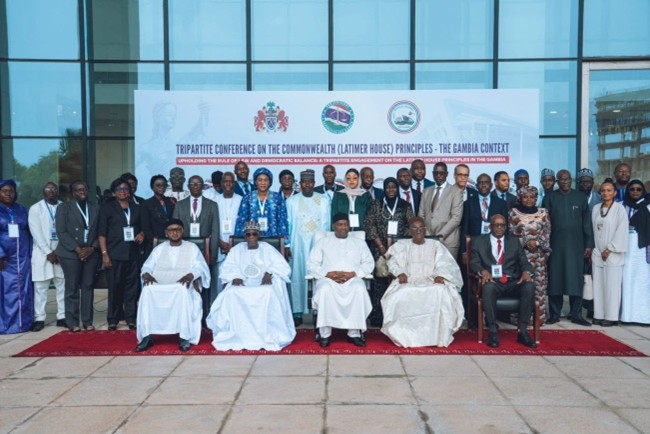
The three-day conference, organised by the Office of the Clerk of the National Assembly and held at the Sir Dawda Kairaba Jawara International Conference Centre in Bijilo, is themed: “Upholding the Rule of Law and Democratic Balance: A Tripartite Engagement on the Latimer House Principles in The Gambia.”
The landmark gathering is aimed at deepening cooperation among the three arms of government while safeguarding their constitutional independence and strengthening democratic governance in the country.
Addressing delegates, President Barrow described the conference as a significant milestone in The Gambia’s democratic journey, stressing that democracy can only flourish when the Executive, Legislature and Judiciary operate independently while working together in the national interest.
“The strength of our nation lies not in the dominance of one institution, but in the balance among all three branches of government,” President Barrow said.
He noted that the Latimer House Principles promote institutional independence, accountability, transparency and respect for the rule of law, values he said remain fundamental to The Gambia’s democratic consolidation.
According to the President, the conference provides an important platform for dialogue and cooperation as the country continues to build resilient democratic institutions capable of delivering justice, protecting rights and ensuring sustainable development.
“As we continue this important dialogue, let us reaffirm our collective commitment to democracy, constitutional governance and the rule of law,” he urged.
Chief Justice Hassan B. Jallow described the conference as a historic moment for The Gambia’s constitutional development, saying it reflects a shared commitment to strengthening democratic governance and ensuring that each arm of government performs its constitutional mandate while respecting the independence of the others.
He emphasised that judicial independence is not a privilege for judges but a constitutional guarantee designed to protect the rights and freedoms of every citizen.
“Judicial independence exists to ensure that every person receives impartial justice based solely on the law and evidence,” the Chief Justice stated.
Justice Jallow further stressed that no institution should dominate another, noting that the health of any constitutional democracy depends on all state institutions operating within their constitutional limits while remaining accountable to the people.
He also welcomed the establishment of structured dialogue among the heads of the three branches of government, describing it as an important step towards improving coordination and strengthening constitutional governance.
National Assembly Speaker Fabakary Tombong Jatta said the conference provides a rare opportunity for the three branches of government to reflect collectively on their constitutional responsibilities and develop practical mechanisms for cooperation without compromising institutional independence.
“The separation of powers should never be misconstrued as separation of purpose,” Speaker Jatta said.
He noted that Parliament cannot effectively discharge its oversight responsibilities without an accountable Executive and an independent Judiciary that enjoys public confidence.
The Speaker further expressed optimism that the conference would produce practical outcomes, including a National Action Plan for implementing the Latimer House Principles in The Gambia.
Speaker Jatta also paid tribute to Chief Justice Hassan B. Jallow ahead of his retirement later this year, commending his outstanding contribution to judicial independence, constitutional governance and the rule of law.
Clerk of the National Assembly Kalipha M.M. Mbye described the conference as a defining moment in The Gambia’s constitutional evolution, noting that it is the first time the Executive, Legislature and Judiciary have deliberately convened to discuss practical implementation of the Commonwealth Latimer House Principles.
“This conference did not happen by chance. It is the result of deliberate institutional reflection and sustained collaboration,” Mbye said.
He explained that the conference seeks to strengthen constitutional relationships rather than redefine constitutional mandates.
Among the expected outcomes, he disclosed, are the development of a National Action Plan on the implementation of the Latimer House Principles, a Tripartite Communiqué and a Memorandum of Understanding to institutionalise regular engagement among the three organs of state.
According to him, these instruments will serve as lasting governance frameworks that reinforce constitutional practice and democratic consolidation.
Legal practitioner Ousman Jammeh underscored the importance of the Latimer House Principles in safeguarding judicial independence, parliamentary autonomy, accountability and transparency.
Reflecting on The Gambia’s democratic journey before and after 2016, Jammeh said respect for the separation of powers remains essential for preventing abuse of authority and ensuring good governance.
He observed that the country’s democratic transition was driven by citizens’ desire to restore constitutionalism, the rule of law and accountable governance after years of institutional imbalance.
“The checks and balances among the three branches of government remain indispensable for any viable democracy,” he said.
The Commonwealth Latimer House Principles, adopted by Commonwealth Heads of Government in 2003, provide internationally recognised guidelines on the relationship between the Executive, Legislature and Judiciary. They promote judicial independence, parliamentary autonomy, executive accountability and respect for the rule of law while encouraging constructive engagement among the three arms of government.
As The Gambia continues its democratic reform agenda, participants expressed hope that the conference will strengthen institutional cooperation, reinforce constitutional governance and position the country as a model for democratic best practice within the Commonwealth.
Source: The Point