CJ Jallow warns: Without justice, there can be no peace

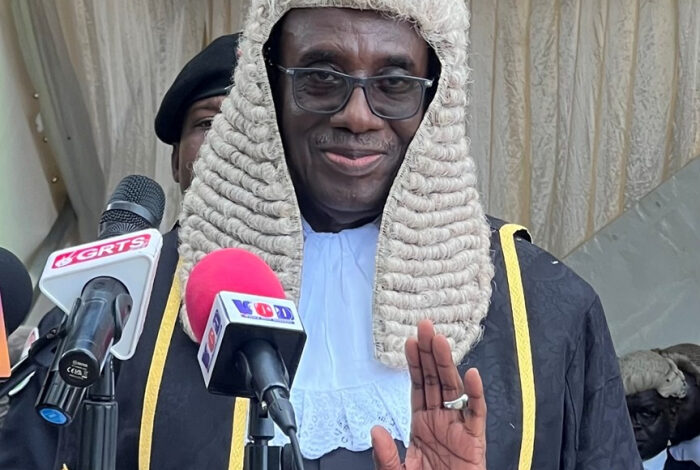
In a powerful farewell message after five decades of service, The Gambia’s retiring Chief Justice His Lordship Hassan B. Jallow warned that justice, peace and development are inseparable, declaring that “without justice there can be no peace, and without peace there can be no meaningful national progress.”
Speaking at a Judicial Farewell Ceremony in his honour, Jallow urged Gambians to uphold the supremacy of the Constitution and safeguard judicial independence, stressing that equality before the law is the cornerstone of freedom, democracy and national stability. His remarks, delivered as he bows out at the constitutional retirement age of 75, underscored the enduring link between the rule of law and the nation’s future.
After five decades of distinguished service, The Gambia’s first ever Chief Justice, Hassan B. Jallow, bowed out on Monday with a powerful call to judicial officers to safeguard independence, impartiality and excellence. He stressed that judges must be guided only by the Constitution, the law, the evidence before them and their conscience.
The farewell ceremony, held at the Law Courts Complex in Banjul, brought together members of the Judiciary, Executive, Legislature, diplomatic corps, legal profession, development partners, family and dignitaries to celebrate his career. His retirement, effective 1 August upon reaching the constitutional age of 75, marks a historic milestone as the first orderly retirement of a Gambian Chief Justice.
Delivering his farewell address, Justice Jallow declared: “No national legacy provides a stronger foundation for future generations than a justice system anchored on an independent judiciary, respect for human rights and the rule of law.”
He urged Gambians, regardless of status, to uphold the supremacy of the Constitution. “Equality before the law is essential for preserving freedom, democracy and national stability. We must strive to make our society a community of justice if we are to remain a nation of peace and progress.”
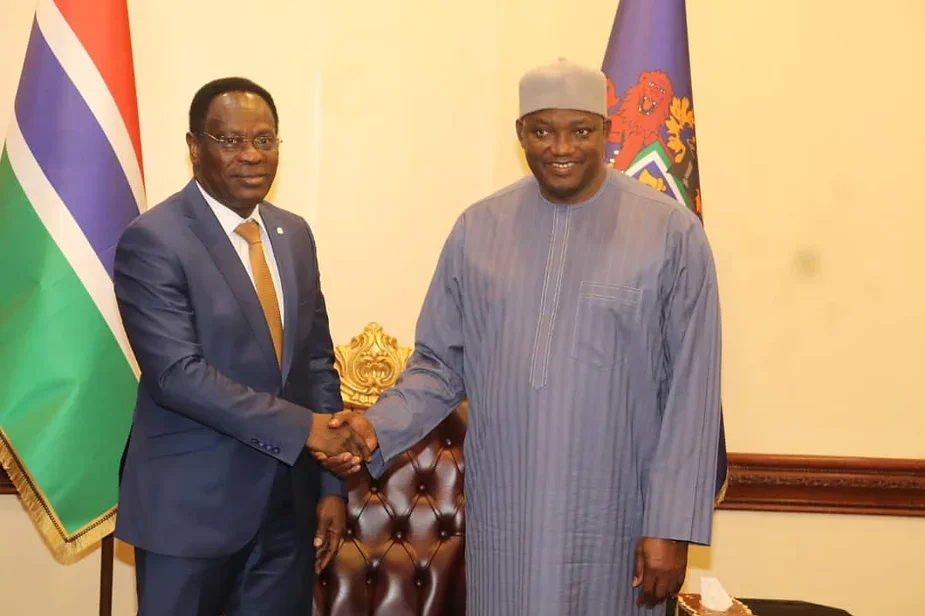
He reminded judicial officers that independence is not a personal privilege but a safeguard for the nation. He also praised President Adama Barrow’s administration for respecting judicial independence by implementing court decisions without interference, while cautioning that the gains achieved must be protected and consolidated.
Reflecting on his career, Jallow described his retirement as the conclusion of “a long journey for justice”, spanning half a century of service in The Gambia and internationally. He served all three arms of government — as Attorney General and Minister for Justice in the Executive, as an ex‑officio Member of Parliament in the former House of Representatives, and later as Chief Justice heading the Judiciary.
Internationally, he worked with the African Union, Commonwealth and the United Nations, notably as Chief Prosecutor of the International Criminal Tribunal for Rwanda, where he contributed to the prosecution of genocide, crimes against humanity and war crimes.
Since his appointment as Chief Justice in 2017, Jallow oversaw significant reforms, but acknowledged that much work remains in strengthening access to justice, expanding infrastructure, embracing technology and building institutional capacity. He maintained that the achievements recorded during his tenure represent a collective legacy shared by the Judiciary, Government, legal profession, development partners and the Gambian people.
Tributes flowed from across the legal fraternity. Neneh Cham, President of the Gambia Bar Association, described him as a jurist synonymous with integrity, scholarship and reform. She recalled his career beginning in 1976 as State Counsel before rising through the ranks to become Principal State Counsel, Solicitor General, Attorney General, Supreme Court Justice and later Chief Prosecutor of the UN Tribunal for Rwanda.
Cham credited him with restoring confidence in the Judiciary after his return in 2017, and championing reforms such as digitisation of court processes, revision of century‑old rules, and expansion of alternative dispute resolution mechanisms.
Attorney General Dawda A. Jallow described the occasion as both historic and personal, noting that Justice Jallow is the first Gambian Chief Justice to retire in accordance with the Constitution. He praised Jallow’s calm and principled leadership, which strengthened judicial independence and reinforced constitutional governance.
“The Judiciary he leaves behind is stronger, more confident and more firmly anchored in constitutionalism than the one he inherited,” the Attorney General said.
He also highlighted Jallow’s contributions to legal scholarship, including The Law of Evidence, Journey for Justice, Law, Justice and Governance and Accountability for International Crimes. Chapter 10 of Law, Justice and Governance, focusing on the role of law officers, will now be recommended reading for State Counsel.
As he departs, Justice Jallow’s orderly retirement sends a powerful message: that the Gambian Judiciary is governed by constitutional principles rather than personalities. His legacy, built over five decades, will continue to shape Gambian jurisprudence and inspire future generations of legal practitioners.
Source: The Point