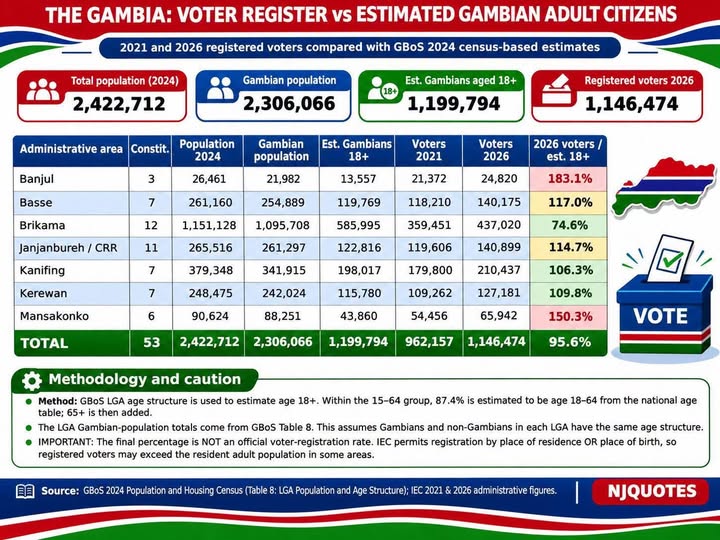
95.6% of the estimated adult Gambian population is on the 2026 voter register!

by Ndey Jobarteh
I have really appreciated the debate around the IEC’s final voter-register figures. This is how it should be: questioning, doubting, challenging, explaining, correcting and learning from each other.
That is one of the beauties of social media. We can disagree, agree to disagree, test each other’s arguments and still come away knowing more than we did before.
Some people have rightly pointed out that census figures and voter registration figures are not the same thing. I agree.
The census tells us about the population!
The voter register tells us who is registered to vote!
But different datasets can still be compared carefully to provide context, test plausibility and raise legitimate questions.
So I went back to the 2024 GBoS Population and Housing Census and tried to adjust for two important factors:
1. Age: because children cannot vote.
2. Nationality: because only Gambian citizens can register to vote.
Using the census population, nationality and age structure, the estimated number of Gambian citizens aged 18+ is approximately 1.20 million.
The IEC reports 1,146,474 registered voters in 2026.
That puts the voter register at roughly 95.6% of the estimated Gambian adult citizen population.
Now, this is NOT an Official Voter registration rate.
There are important limitations.
People may be counted by the census where they currently live but register to vote in their place of birth.
Internal migration can therefore create major differences between an area’s resident population and its voter roll.
Gambians living abroad may also remain registered.
But this brings me back to one of the most important questions United Democratic Party, UDP has raised throughout this process: RECONCILIATION.
The issue is not only what the final number is. The issue is:
How did we get there?
How was the 2021 register updated before arriving at 1,146,474 registered voters in 2026?
How were duplicate registrations identified and removed?
How many deceased voters were removed?
How many records were corrected?
How many were transferred?
How many were restored?
How many were deleted for reasons other than duplication?
How are Gambians living abroad reflected in the register?
And what official databases and verification systems were used to reconcile the existing register with the 2026 supplementary registration?
That is why reconciliation matters! The final figure alone does not answer those questions.
This is also where I believe census and demographic data become useful, not as a replacement for the voter register, but as an independent benchmark.
And beyond this election, it should also be a benchmark for fixing and strengthening our electoral system.
If census data, civil registration, death records, migration information and electoral records can be better linked and regularly reconciled, then we reduce uncertainty, remove outdated records, improve accuracy and strengthen public confidence in the register.
So for me, this analysis is not about asking whether the register can be explained, reconciled and independently scrutinised.
But these figures justify questions.
And that, for me, is what intellectual curiosity and civic engagement should look like:
question the numbers, test assumptions, listen to explanations, correct ourselves where necessary, and keep digging until the figures make sense.
And while we are digging into these numbers, I have to call on Joey Goswell:) lol Joey has always been a guru when it comes to electoral numbers and figures, and during the struggle he helped many of us understand them. Joey, I hope you will jump into this discussion too:) lol
I also want to give credit to United Democratic Party official – The Gambia, UDP and their entire Team for bringing the reconciliation of the voter register to public attention. Whatever one’s political affiliation, asking how these figures were arrived at is an important question for electoral transparency.
Please, if you are a registered Gambian voter, go out and vote on 5 December!
Your vote matters!
And if you are not a Gambian citizen but somehow hold a Gambian voter’s card, please do not attempt to vote.
Holding a card does not make someone legally eligible if the citizenship requirement is not met.
Protecting the integrity of the election is everybody’s responsibility.
Vote if you are eligible! Do not vote if you are not!
Sources: GBoS 2024 Population and Housing Census and IEC voter-registration figures.