
Gambia stands at crossroads as Senegal battles whirling HIV issue

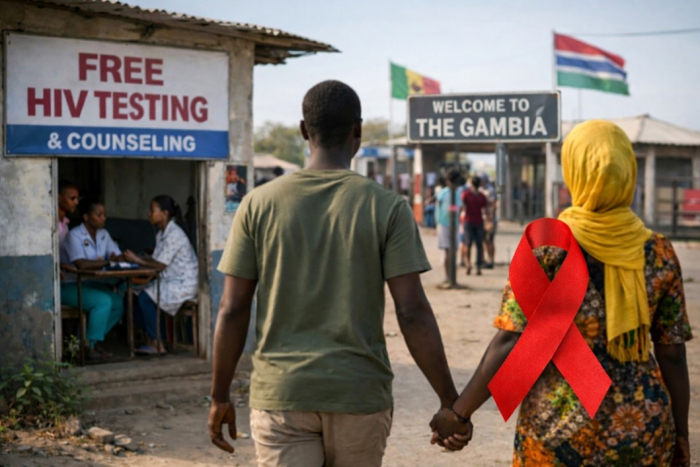
The border between The Gambia and Senegal is one of the most fluid in West Africa. Families live on both sides. Traders cross daily. Students commute. Religious leaders preach across territories. News travels in minutes.
So when controversy erupted in Senegal involving arrests and public narratives linking alleged “unnatural acts” with HIV transmission, the ripple effects were immediate. Radio discussions intensified in Banjul to Brikama. Social media debates turned accusatory. Fear began to circulate quietly through communities already vulnerable to misinformation.
For The Gambia, this is not foreign drama. It is a regional public health moment demanding clarity, leadership and restraint.
Will science guide the response, or will stigma undo decades of progress?
A Mother’s Survival: Living Proof of Progress
Before statistics, there are human lives.
“I was born with the virus because my parents were infected,” a Gambian woman shares. Her voice carries both loss and strength. “I have eight children. The first four passed away. The other four are healthy and HIV-negative.”
Her story spans two eras of the epidemic. The early years, when treatment was scarce and prevention limited. And the modern era, where antiretroviral therapy protects both mothers and babies.
“When I tested positive, I was not too worried. I saw my parents live with it. I thank God I am still alive.”
But survival has conditions.
“The medication is strong. It makes you hungry immediately. We need food support and financial help. Some people struggle to stay on treatment because of poverty.”
Her testimony reminds the nation that medicine alone does not end epidemics. Social support sustains adherence.
National Progress and Dangerous Gaps
The 2024 Annual Report of the National AIDS Secretariat presents encouraging progress in The Gambia’s HIV response.
There are 11,187 Gambians currently on life-saving antiretroviral treatment. Among those tested for viral load, 79 percent have achieved viral suppression. This means they cannot transmit HIV sexually, a scientific fact globally reinforced by UNAIDS under the principle Undetectable equals Untransmittable.
The national HIV prevalence remains at 1.29 percent, one of the lowest in sub-Saharan Africa.
Yet the same report reveals troubling realities. Only 64 percent of people living with HIV know their status. Approximately 9,000 Gambians may be living with HIV without awareness. Only 44 percent of all people living with HIV nationwide are currently on treatment.
These numbers show progress, but they also expose vulnerability.
Hamadi Sowe: A Public Health Warning Against Moral Panic
Hamadi Sowe, a seasoned public health professional with extensive experience in HIV programming, cautions that public narratives linking HIV positive status to promiscuity, risk reversing hard-earned gains in the advocacy efforts.
He explains that HIV is transmitted only through specific exposures: unprotected sex with an infected and untreated partner, sharing contaminated needles, infected blood transfusions, and mother-to-child transmission during pregnancy, childbirth or breastfeeding. It is not transmitted through proximity, sharing cutlery, or social association like shaking hands, etc.
When media coverage sensationalises HIV or merges it with moral judgment, stigma intensifies. Stigma discourages testing. It pushes individuals away from health services. It creates hidden epidemics.
For a country like The Gambia, surrounded geographically by Senegal and deeply interconnected socially and economically, stigma can spread as quickly as misinformation.
Dr Ismail D. Badjie: The Science of Prevention Is Stronger Than Ever
Dr Ismail D. Badjie, Founder and Chief Executive Officer of Innovarx Global Health, emphasises that The Gambia possesses the scientific tools necessary to prevent new infections.
He advocates for combination prevention. This includes consistent and correct condom use, regular HIV testing, reducing concurrent sexual partnerships, avoiding shared needles or sharp instruments, ensuring sterile medical procedures, and expanding access to preventive medicines.
Pre-Exposure Prophylaxis, known as PrEP, is a daily medication taken by HIV-negative individuals at substantial risk. When taken consistently, it is more than 99 percent effective at preventing sexually transmitted HIV. Post-Exposure Prophylaxis, or PEP, must be initiated within 72 hours of potential exposure.
Dr Badjie notes that PrEP rollout in The Gambia is still in early stages, supported through frameworks financed by The Global Fund to Fight AIDS, Tuberculosis and Malaria and implemented with partners such as ActionAid. Expanding access, particularly among key populations where prevalence ranges between 14 and 31 percent, is urgent.
He underscores testing as the foundation of the entire HIV response. Sexually active adults should test at least once a year. Individuals with multiple partners should test every three to six months. Pregnant women should test at every antenatal visit. In 2024 alone, over 77,000 pregnant women were tested, with 98 percent of those who tested positive linked to care.
“You cannot treat what you do not diagnose,” he stresses.
A Counselor’s Journey: From Collapse to Advocacy
A second woman recounts discovering her HIV status during a routine pregnancy check-up in 2005 at Brikama Hospital: “When I was told I was positive, I could not accept it. I had heard people say HIV patients do not live long. I stopped eating. I stopped functioning. The stress caused me to lose my baby.”
Her mental health deteriorated before she could begin treatment. The loss still lingers.
Later, when she became pregnant again and tested positive, she chose acceptance. She registered for care. She attended regular check-ups. Over time, her visits reduced from monthly to every six months. Today, she is healthy and works as a counselor supporting others who struggle with disclosure and denial.
“HIV is just like any other illness. Accept it and take your medication. If I did not tell you, would you know I have it?”
She raises a pressing concern about confidentiality in health facilities. Some patients fear being identified when collecting medication. Stigma within communities discourages attendance at clinics.
Her life demonstrates that treatment works. Her advocacy shows that stigma remains.
Mama Gassama, Country Coordinator at GAMNASS, highlights the growing vulnerability of adolescents.
She observes that young people as young as fifteen are living with HIV. In a technology-driven era, exposure to risky behavior occurs without adequate parental guidance or accurate health education.
She emphasises that HIV medication in The Gambia is free and highly effective. However, stigma continues to deter open discussion. She calls on parents, teachers and community leaders to speak honestly with youth about sexual health and prevention.
Mariama Cham, a social worker, emphasises that families and communities must respond to people living with HIV with compassion, care, and without judgment, noting that they already struggle with social acceptance. She says isolation and blame only deepen their difficulties, while empathy, encouragement, and respect help restore dignity.
She further stresses the importance of learning accurate information about HIV, safeguarding confidentiality, and treating those affected as equals to combat stigma and discrimination. According to her, building a supportive and inclusive environment enables people living with HIV and their children to lead healthy, confident, and fulfilling lives.
Funding, Policy and Cross-Border Reality
Despite commendable progress, The Gambia faces a funding gap exceeding 52 million dollars in its HIV response. While international support remains vital, experts argue that increased domestic investment is necessary to sustain momentum and strengthen sovereignty over public health programming.
Cross-border collaboration with Senegal must also be formalised and strengthened. Shared geography demands shared health strategies. Surveillance, prevention messaging and referral systems should operate seamlessly across borders.
Senegal’s earlier success in engaging influential Islamic brotherhoods to normalise HIV testing offers lessons. Faith leaders in The Gambia can similarly serve as champions of compassion and accurate information, reinforcing that HIV is a health condition, not a moral failing.
The Defining Choice for The Gambia
The Gambia has built a formidable HIV response over four decades. Thousands are alive today because treatment was accessible. Viral suppression rates are strong among those retained in care. Prevention of mother-to-child transmission has protected countless infants.
Yet approximately 9,000 Gambians may be living with HIV unknowingly. Treatment coverage remains incomplete. Key populations remain underserved. Youth infections present new challenges.
The events in Senegal are a reminder of how quickly public discourse can shift from health to hostility.
The virus does not require a passport. Neither does fear nor compassion.
The Gambia now stands at a decisive moment. It can allow stigma to erode trust and silence testing. Or it can reinforce a response rooted in science, dignity, faith leadership and community solidarity.
Ending AIDS by 2030 is achievable. The tools exist. The medication is available. The data is clear.
The remaining question is whether society will match scientific progress with empathy and courage.
The answer will determine not only the trajectory of HIV in The Gambia, but also the moral strength of the nation itself.
Picture: AIGenerated
Source: The Point