CBG CUTS INTEREST RATE AGAIN, PREDICTS STRONGER ECONOMY


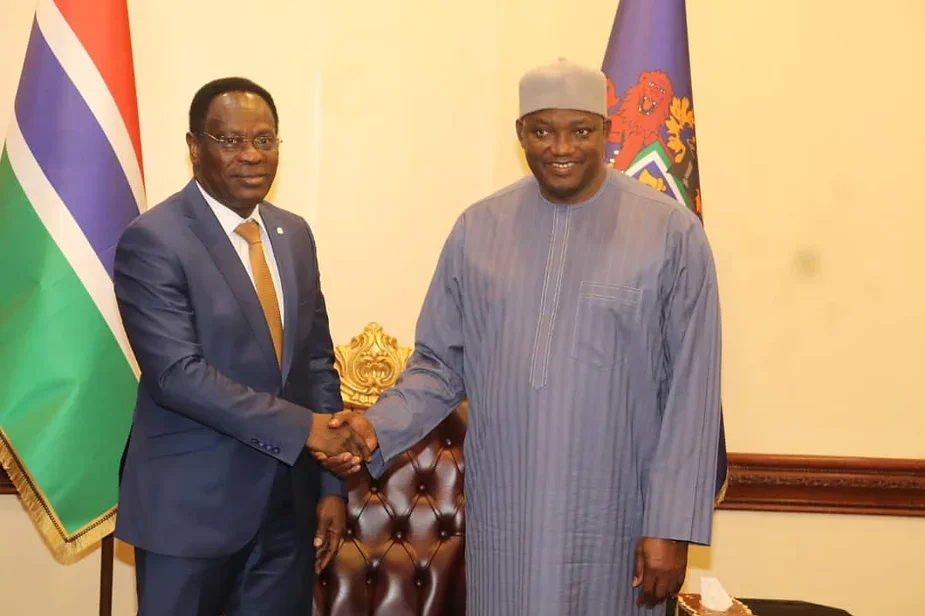
The governor of the Central Bank of The Gambia, Buah Saidy, yesterday announced the cutting of the monetary policy rate by 200 basis points to 14 percent. This is the second time in as many quarters that the bank is cutting the rate which is the key lending rate of the bank.
This decision was announced at the bank’s first monetary policy committee meeting of the year 2026 in Banjul. According to the governor, the decision was made following an assessment of domestic and global economic conditions and the near-term outlook and it reiterates the bank’s commitment to supporting economic growth, improving macroeconomic stability and stemming inflation. The decision is expected to lower interest rates at commercial banks which would allow customers to borrow at lower rates as well as support investment, jobs and services.
Governor Saidy announced that the required reserve ratio of commercial banks is maintained at 13 percent: the interest rate on standing deposit facility at 5 percent while the interest rate on the standing lending facility declines to 15 percent equivalent to the monetary policy rate plus 1.0 percentage point.
Inflation
The governor reported that domestic price pressures are easing indicating a sustained moderation in inflationary pressures with headline inflation declining to 6.4 percent in January 2026 from 6.6 percent in December 2025.
He noted that food inflation on the other hand fell to 6.2 percent in January from 6.4 percent in December 2025.
“In January 2026, core inflation which excludes energy and volatile food items, fell to 3.4 percent from 3.7 percent in December 2025. The disinflation path is expected to progress with headline inflation projected to decline closer to the central bank’s medium-term target by the end of 2026,” Governor Saidy stated.
Growth
According to the governor, the Gambian economy is projected to further strengthen in 2026 despite heightened global uncertainties. Growth is forecasted to moderate slightly to 6.2 percent in 2026 from 6.4 percent in 2025. These projections are premised on robust private and public investment, stable remittance inflows, and improved performance in the services, construction and agriculture sectors.
Forex sector
Governor Saidy also reported that aggregate foreign currency purchases and sales amounted to US$2.4 billion in 2025 from US$2.2 billion in 2024. Private remittance inflows reached US$872.1 million in 2025, a 12 percent increase from the previous year. From September 2025 to December 2025, the dalasi depreciated by 0.5 percent against US dollars, 0.1 percent against pounds and 2.2 percent against the CFA franc.
Banking sector
According to Governor Saidy, banks total assets increased to D128.6 billion in 2025 up from D100.1 billion a year earlier. Meanwhile, total customer deposits increased by 25.6 percent to D83.1 billion in 2025.
Speaking to The Standard in December after the first policy cut in December, an economist at a leading consultancy firm in The Gambia explained: “It is important for your readers to know what a cut to the MPR means for the economy. When the Central Bank of The Gambia cuts the MPR, which is the key interest rate the Central Bank will set to determine the market interest rates, it allows commercial banks to lend to their customers, especially businesses, at a lower interest rate. A business, for example, that plans to expand, but constrained by access to finance, can now borrow from its bank at a lower rate. An expanded business can lead to employment opportunities, better services, and products. The ripple effects are more business activities, employment creation, better goods and services, and improved standards of living.”
Source: The Standard