EU Explains Position On Barrow’s Third Term

The European Union has explained why it has not condemned President Adama Barrow’s controversial third-term bid.
The EU has consistently championed term limits in Africa as a safeguard for democratic consolidation. In Senegal, Guinea and Côte d’Ivoire, it spoke out when leaders tried to circumvent constitutional limits.
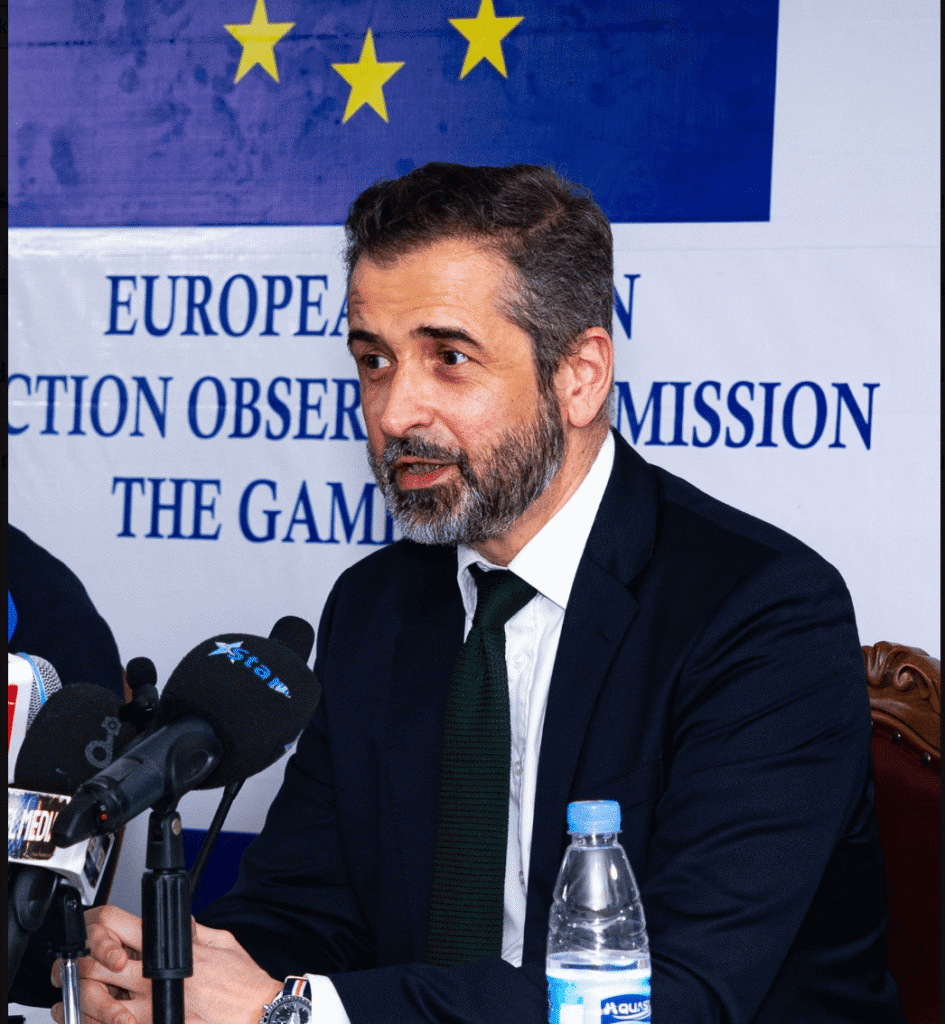
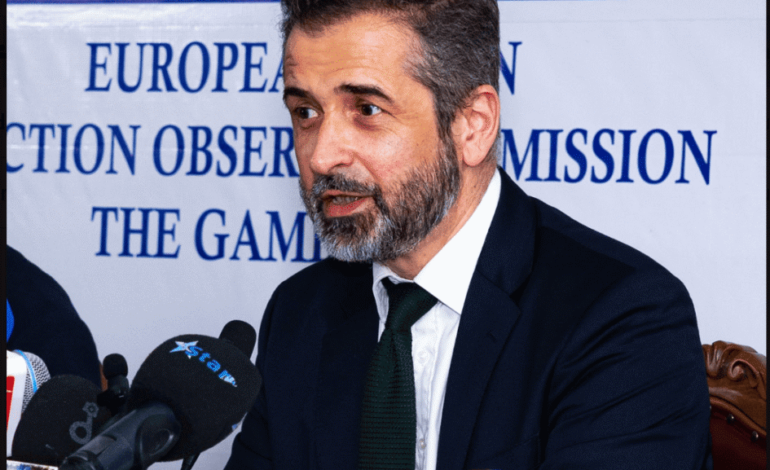
But according to Stéphane Mondon, deputy chief observer of the EU Election Observation Mission (EU EOM) in The Gambia, that principle has not changed but is not applicable in the case of The Gambia.
Mondon told The Standard in an exclusive interview that the European Union has stayed silent because The Gambia’s Constitution imposes “no term limit”.
The Gambia’s 1997 Constitution, enacted under Yahya Jammeh, contains no two-term limit. Two attempts to adopt a new constitution with a term limit failed, leaving Barrow’s bid legally permissible, even as opposition candidates, including UDP leader Ousainu Darboe, promise a single term if elected.
“In The Gambia, the constitution doesn’t set any term limit. That’s why we haven’t said anything because there’s no infringement of the law, or the legal framework,” Mondon said.
He argued that if there was a term limit in the Gambian constitution or the election law and someone was trying to breach it, the mission would have mentioned it.
“But it’s not the case as of now in the country. So if candidates respect the law of the country, we don’t comment. It’s the sovereign issue of the country to respect,” he explained while stressing the mission’s core principle of non-interference.
With 16 long-term observers deployed nationwide, Mondon said the EU is monitoring campaign violence, hate speech, media access and abuse of state resources.
“We don’t come here to validate or invalidate the result of the election. We are not the arbiters of this process. However, if we see something that could threaten the will of the voters, including in the announcement of the result, we will definitely say it,” he explained.
Commenting on the opposition’s concerns over the IEC’s credibility to conduct a free and fair election, Mondon said it was “a bit early to say” if the IEC is fully prepared, but he praised the transparency the commission demonstrated during the nomination of presidential candidates.
Mondon said the EU Observers are also paying attention to the advantage of the incumbent and monitoring the media.
“We monitor to see if the media gives a level playing field to all candidates, and if the narrative is not inflammatory or targeting a specific ethnic group.”
He added that journalists should be able to exercise their profession in complete freedom.
“If you disagree with a report, you have the right to reply. You don’t have the right to attack the journalist.”
Reacting to the peace pact signed by all candidates, Mondon said: “The fact that all candidates, including the incumbent, signed, is definitely a positive step. An election is a fight of ideas. It is not a fight of people.”
He said the mission will release its preliminary statement on 7th December, two days after voting.
“We will draw conclusions for the election and also recommendations.”
Source: The Standard