Nigeria: WHO warns DR Congo Ebola outbreak ‘far from being under control’

By Zuleihat Owuiye, Nigeria
The World Health Organization has warned that the Ebola outbreak in the Democratic Republic of Congo is spreading faster than any previous epidemic and remains “far from being under control,” with more than 2,300 people already dead.
WHO Director-General Tedros Adhanom Ghebreyesus made the statement on Tuesday during an emergency meeting on the outbreak, now the deadliest in the country’s history.
“We must be frank: the epidemic is far from being under control,” Tedros said. “It had a big head start, and we are still playing catch-up.
DRC’s Ministry of Health reported on Monday that the outbreak, declared on May 15, has killed more than 2,300 people out of nearly 5,000 confirmed cases.
Health officials believe the virus had been circulating for several weeks before it was officially declared. It is the country’s 17th Ebola outbreak.
The current death toll has already surpassed the previous record of 2,299 deaths recorded during the 2018-2020 outbreak in eastern DRC.
According to the Africa Centres for Disease Control and Prevention, the outbreak is moving at unprecedented speed. In the first three months, DRC recorded seven times more cases and five times more deaths than during the same period of the 2013-2016 West Africa epidemic, which killed more than 11,300 people in Liberia, Sierra Leone and Guinea.
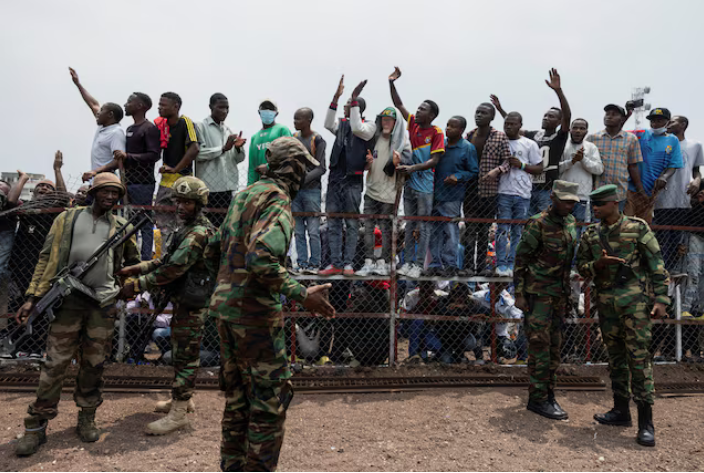
Tedros said the outbreak is being fueled by insecurity, displacement, and heavy population movement along roads, rivers, and mining routes in the north and east of DRC.
The affected regions have weak state presence, poor health infrastructure, and have been impacted by armed groups for decades. Cases have now been reported in six DRC provinces, including areas near the border with South Sudan, as well as in neighboring Uganda.
“The risk of further national and international spread remains high,” Tedros warned.
WHO currently rates the public health risk as “very high” inside DRC, “high” for Uganda and other bordering countries, and “low” for the rest of Africa and the world.
The outbreak is caused by the Bundibugyo strain of Ebola, for which there is currently no approved vaccine or specific treatment. Clinical trials are underway.
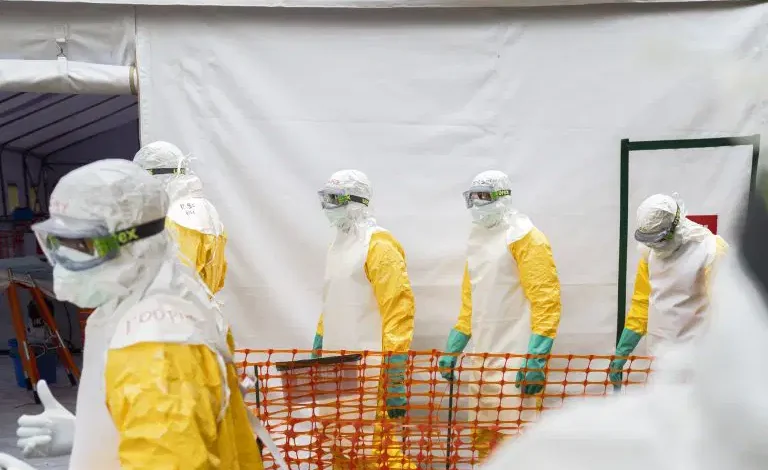
Ebola spreads through contact with bodily fluids and causes hemorrhagic fever. Tedros said his greatest concern is that people are dying at home and in communities, outside treatment centers and outside known contact lists.
“Every death like that points to a chain of transmission we have not yet found,” he said. “Until every chain is found and broken, the epidemic will continue.”
Dieudonne Mwamba, head of the DRC’s Institute of Public Health, told AFP that community resistance explained the rise in cases and deaths over the past three to four weeks. “Addressing that will require other strategies,” he said.
On Tuesday, WHO experts outlined steps to decentralize the response and bring it closer to affected communities.
WHO’s Thierno Balde, speaking from Bunia, said the organization is working to better protect motorcycle taxi drivers who transport patients and to integrate them into the surveillance system.
Other measures include expanding treatment centers, increasing community engagement, and strengthening contact tracing in hard-to-reach areas.
“WHO and partners aim to see an impact of the scale up in the next months but cannot put a timeline on when the epidemic will be brought under control,” Balde said.
This was the second meeting of the WHO emergency committee since it declared the outbreak a Public Health Emergency of International Concern on May 17, WHO’s second-highest alert level.
Tedros said new recommendations for DRC and other at-risk countries would be issued in the coming days and called for stronger regional cooperation to contain the virus.
He urged governments to share information, secure borders, and support cross-border surveillance.
“The epidemic is being fueled by insecurity and displacement,” he said. “We need governments to cooperate in fighting the outbreak.
With cases confirmed in Uganda and proximity to South Sudan, health officials are particularly concerned about regional spread. Cross-border trade, mining, and refugee movements make containment more difficult.
The Africa CDC has described the outbreak as spreading faster than any previous Ebola epidemic on the continent.
For now, WHO says the priority is finding every transmission chain, improving community trust, and bringing care closer to where people live.