
Nigeria: Inside new Bell Prison: How inmates in Cameroon built their own record label behind bars

By Zuleihat Owuiye, Nigeria
Built to hold about 1,200 people, it now houses more than 4,700. The walls are crumbling. Cholera has spread through overcrowded cells. In 2008, guards shot 16 inmates during an attempted breakout. Human rights groups call it one of Cameroon’s most notorious jails.
It’s called Jail Time Records. And over the last six years it has turned a tiny, sweaty recording booth into a studio that’s producing music heard as far away as South Africa, the US, and Argentina.
The studio is rudimentary. One small booth, one computer, and a lot of heat. Yet it’s become the heart of creative life at New Bell.
Jail Time Records was started in 2018 by Italian artist Dione Roach and former inmate Steve Happi. Roach had volunteered to run arts events inside the prison. During a dance class, a group of rappers grabbed the microphone and started freestyling. She was struck by their talent and asked prison authorities if she could set up a studio.
Happi, who had been jailed after a family dispute over his father’s burial — he was later acquitted — became the studio’s producer and sound engineer. Together, they began recording.
“It’s this instrument of resistance… where we can really share friendship, love and our voices can be heard,” Happi told the BBC’s _Talking Movies_ programme.
“We don’t think anymore about the four walls — we find the freedom.
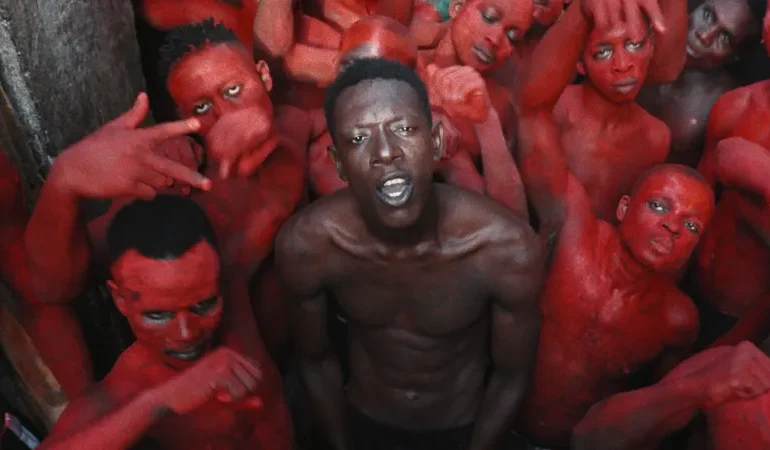
Empereur, a prisoner serving 10 years and described as a feared gang leader inside and outside, has become one of Jail Time’s breakout names. His video for _Sa Ngando_, filmed entirely in New Bell, has more than 24,000 views on YouTube.
Another artist, Stone, is a former soldier in Cameroon’s presidential guard. He’s serving 10 years for robbery and illegal possession of firearms, a charge he says is false. In the documentary, he raps:
“Heart of stone, it’s war. My senses shatter like broken glass.
I’m closed and tight like a cell door. No solid ground I slip like a fish.”
The film also follows Stone trying to call his young daughter, Maira. After failing to reach her, he leaves a voice note: “It’s been a long time. She needs to hear my voice from time to time, so she doesn’t forget about her father.”
In February, Jail Time put on a huge concert in the prison courtyard. Inmates climbed onto corrugated roofs for a better view as performers took the stage. The prison director attended — and danced with the artists.
The story of the studio is now the subject of an award-winning documentary also called _Jail Time Records_.
Filmed over six years by Roach and Happi, the film premiered last month at New York’s Tribeca Festival, where it won three prizes including Best Documentary Feature. Oscar-winning director Taika Waititi and singer Rita Ora served as executive producers.
“Just in terms of the power of art in relation to redemption and what that can mean to someone who… some of these people are in prison for life. I think having an outlet is an incredibly powerful and humane thing,” Waititi said.
The documentary doesn’t shy away from the contradictions. Empereur is shown shaking down a younger inmate for a necklace and flip-flops. Some critics ask whether the project risks glorifying violent offenders.
Roach’s answer is blunt: “The process we’re doing is a rehabilitation process, basically. We enter the prison without any judgment and it’s the only way we can really approach this kind of work. Music… is also a way of self-discovery… coming to terms with things you’ve done and hopefully changing for the better.”
The model is simple: half the profit goes to the artists, half goes back into the label. That money buys equipment, pays for video shoots, and funds new projects.
The label has also expanded. In 2022, Jeje became Jail Time’s first female artist, releasing the Afrobeats track _Show Me The Way_ from the women’s wing.
Nobody show me the way, nobody show me the way, I did it all alone,” she sings. She was jailed after stealing money and fleeing an allegedly abusive uncle.
In 2023, Roach and Happi opened a second studio 1,600km away in Ouagadougou’s central prison in Burkina Faso. The goal is to replicate the New Bell model: label, videos, and performances.
Human Rights Watch reported in 2022 that the prison was at four times capacity. Poor sanitation helped cholera spread during an outbreak four years ago; at least six inmates died. Violence between prisoners is common.
That’s why the studio matters so much to those inside. For a few hours, they are not just inmates. They are artists, producers, directors.
The documentary ends with an “in memoriam” for six prisoners who died while the project was running. It’s a reminder that the creativity exists inside a place that remains bleak.
Cameroon is a deeply musical country, and prison authorities have largely supported the project. For them, music is less a threat than a tool for keeping order and morale.
Songs recorded on a single computer in a sweltering booth are now streaming to listeners on other continents. A label run by convicts is winning awards at Tribeca.
New Bell is still overcrowded, still violent, still tragic. But inside it, Jail Time Records has built something rare: a space where people serving time can imagine a future beyond it.