
BAC tackles Brikama Fish Market stagnant water amid health concern

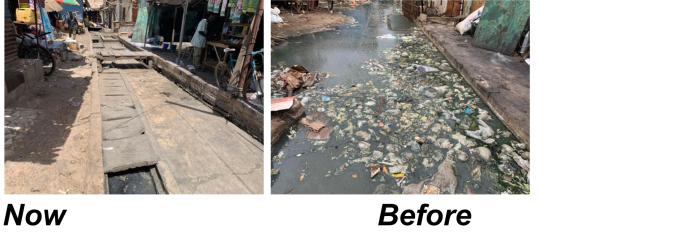
Barely five months after The Point’s publication on the condition of the Brikama Fish Market due to stagnant, unhygienic water, the Brikama Area Council (BAC) has now begun construction of a three-chamber soak way to curb the problem market vendors face.
On the 25th of February 2026, The Point published an article headlined: “Breeding ground for disease: Brikama Market’s silent catastrophe” detailing the unhygienic and deteriorating conditions of the Fish Market located at the heart of the Brikama Market.
In the article, Hon. Musa Drammeh, Minister for Fisheries and Water Resources, acknowledged the situation and outlined his ministry’s plans to address it.
He explained that the fish market was sponsored by the Japanese government and was originally intended to be connected to a sewage system in Brikama, a plan that never materialised. He said septic tanks were installed to accommodate water from melting ice blocks, but misuse has worsened the problem.
The Minister revealed that a Japanese team visited the market in September and October to assess the situation. “We engaged them, and they now know the problem. They are working on engineering solutions to alleviate it,” Hon. Drammeh said.
However, The Point has now been informed the Brikama Area Council started construction of a soakway in the market in early May 2026.
The constructors told The Point that the soakway has three-chambers, 2.50 meters deep, and length of six meters.
Bintou Touray, a woman vendor in the Brikama Market while speaking on behalf of her colleagues praised the council for coming to their aid.
“We are very happy with the construction of this soakway by the council,” said vendor Awa Touray. “For far too long we have suffered here because of unhygienic, stagnant water. Sometimes the smell was so bad that even breathing became a problem. We thank the council for coming to our aid.”
Touray said the dirty water had driven customers away. “None of them wants to step into the water to buy from us,” she said. She added that the water was not only dirty but infested with worms, making conditions unbearable.
“It’s not just the worms; the water itself smells terrible. We endured this filth for years,” she said. “For the Brikama Area Council to rescue us from this condition, we cannot pay them back except with thanks and prayers. We are also praying for you, the journalist, for speaking on our behalf to ensure the market is clean.”
Brikama Area Council reaction
Speaking to The Point, Lamin Singhateh, Public Relations Officer of the Brikama Area Council, explained why the council stepped in despite the Fish Market falling under the Ministry of Fisheries.
“We have a responsibility as long as it is a market,” Singhateh said. “By law and regulation, Brikama Market is under the council. The Fish Market is not, but that does not mean we have no responsibility. The vendors and their customers are our electorate and residents of the West Coast Region.”
He said the council exists to serve the people of the West Coast, and although the facility is not theirs, the beneficiaries are “our mothers and sisters.”
“That is why the council leadership decided to act and help remedy the situation,” he said. “We know the soakway is not a permanent solution, but it can serve temporarily to mitigate the problem.”
Singhateh said the Permanent Secretary at the Ministry of Fisheries, Buba Sanyang, visited the market before work began. “I was not there, but the management team told me they informed him of the council’s intention to build a soakway. I think that counts as consultation,” he said.
Asked whether The Point’s earlier report on the market’s condition influenced the council’s action, Singhateh said he could not say for certain, but acknowledged the story sparked public outcry.
“The Fish Market remains a challenge for the Brikama Area Council. Even though people know it is not under us, anything that happens there is attributed to us. So we felt compelled to do something,” he said.
He added that the council has long supported the Fish Market, including stationing a septic tanker there to drain dirty water daily.
“The story was good and it attracted public outcry,” Singhateh said. “I don’t think any good leader can ignore that.”
Source: The Point